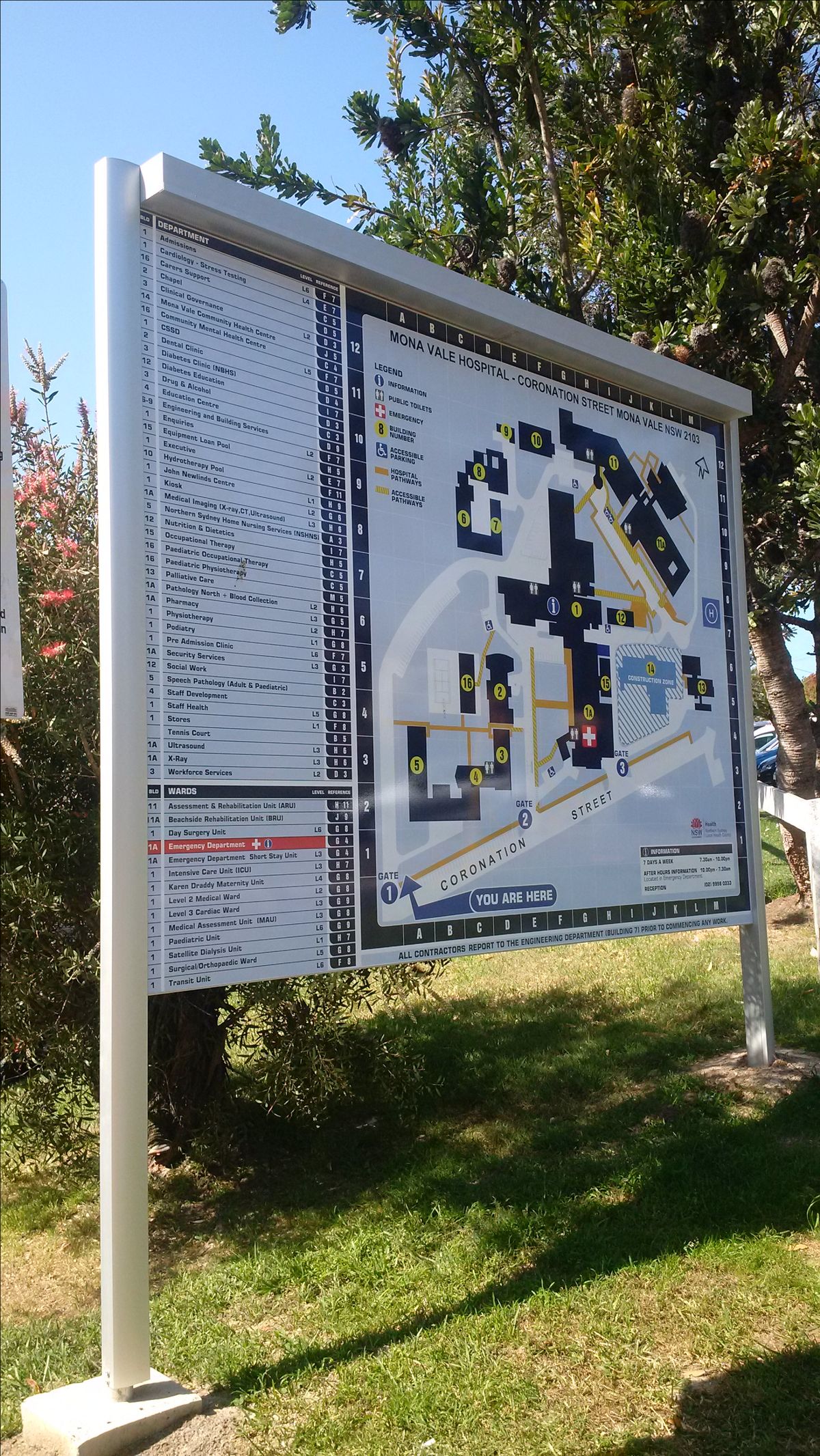
“Let’s put a few maps at the entrance so patients never get lost.”
With this line from his article Why Hospital Maps Do Not Improve Wayfinding, Ralph Michels, patient wayfinding expert and researcher, highlights one of the most common mistakes when addressing navigation in hospitals: assuming that simply showing people a floor plan is enough to help them find their destination.
Let’s look at why a good wayfinding system should not require users to understand the structure of a hospital in order to move through it.
You are here
The familiar “You are here” plans, often located at hospital entrances, require a relatively complex interpretation and involve several factors that can make navigation more difficult. One of them is the rotation effect, which requires additional mental effort when the plan is not aligned with the direction the person is facing.
Another issue is the lack of clear reference points between the plan and the real environment. If key landmarks such as stairs, lifts or changes of level are omitted, it becomes more difficult to connect the graphic representation with what the user can actually see around them.
According to research by Hölscher et al., which analysed user behaviour in a complex made up of several buildings and levels, participants who used maps did not perform better than those who completed the routes without them.
This does not mean that floor plans are always useless. They can help people understand the overall organisation of a building. The question is whether that information really responds to the patient’s immediate need: reaching their destination in the simplest possible way.
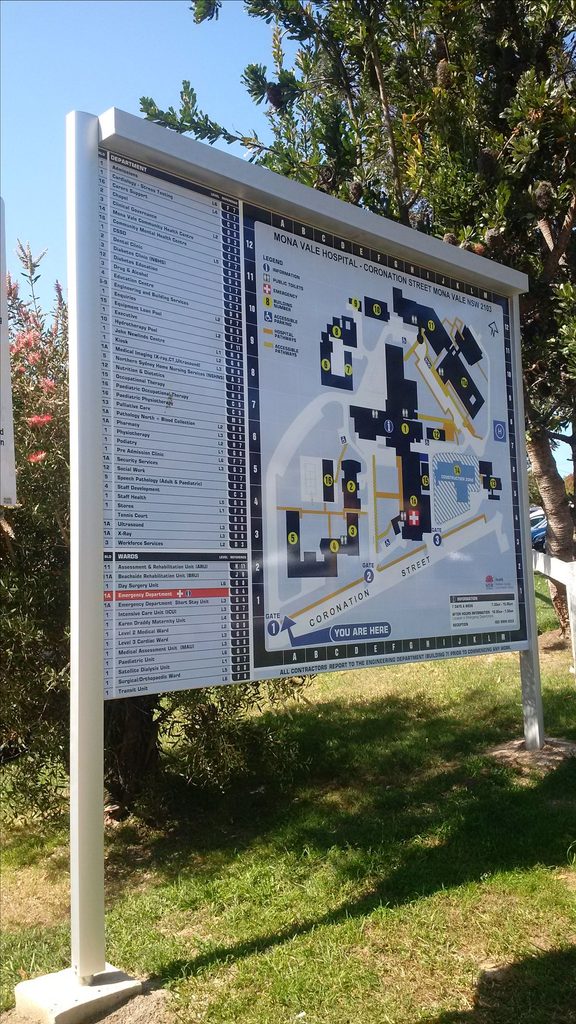
Seeing a red dot that says “You are here” does not always make the feeling of being lost disappear. On a floor plan, knowing where you are does not necessarily mean knowing how to move through the space.
Finding your way and understanding a building plan are not the same thing
One of the key issues lies in the difference between the information provided by a plan and the way we physically move through a building.
A floor plan represents the space from a top-down perspective. The user, however, navigates from their own position. To use the plan, they must mentally translate between these two perspectives: first locating themselves, then identifying the direction they are facing and finally converting that information into a sequence of movements.
This shift in perspective creates a cognitive load that can make navigation more difficult, particularly in large, complex or unfamiliar buildings.
Designing so users do not need to understand the building
To find a consultation room, a patient should not first need to understand the entire structure of the hospital. A wayfinding system should simplify that complexity.
Signage, architecture, visual landmarks, naming systems and digital tools should allow users to move intuitively through the space, receiving the information they need at each decision point.
Teaching visitors how an entire hospital is organised is as ambitious as it is ineffective. The purpose of wayfinding is to enable people to reach their destination independently.