The terms Wayfinding, Wayfinding design and Wayfinding system are often used synonymously. Sin embargo, aunque hacen referencia a la relación lógica entre los distintos niveles de un mismo proceso, no son lo mismo.
In a signage project, differentiating between these three concepts helps to understand what orientation problems exist, to define the scope of the integrated system and with which tools to solve them.
A key distinction for understanding and differentiating concepts
In their work, Arthur & Passini already warned of the confusion between signage and wayfinding. Una forma clara y sintetizada de interpretar su planteamiento es definir los tres conceptos relacionados de la siguiente manera:
- Wayfinding: is a human activity (Passini, 1977).
- Wayfinding design: is a discipline (Arthur & Passini, 1992, 1996).
- Wayfinding system: is the set of tools and interventions(Arthur & Passini in 1992).
If we place these concepts within the complete orientation process, we can say that Wayfinding is the spatial problem solving activity (what people do), Wayfinding Design is the strategy designed by professionals to facilitate that activity, and the Wayfinding system is what is finally implemented in space.
Wayfinding: human activity
The concept of Wayfinding was developed in the late 1970s by R. Passini. Passini amplía y redefine el concepto de “orientación espacial”, enmarcándolo dentro de un proceso cognitivo más amplio.
According to Arthur and Passini, Wayfinding is defined as spatial problem solving, comprising three mental processes: information processing, decision making and decision execution. Es lo que ocurre en nuestra mente cuando interactuamos con el espacio.
When we walk through a place, known or unknown, three basic questions are triggered almost automatically:
- Where am I?
- Where do I want to go?
- How can I get there?
Clearing these unknowns is what is known as Wayfinding, and comprises the set of mental and physical actions that we perform when:
- we are located,
- we make decisions,
- we confirm that we are doing well,
- and correct if something goes wrong.
Wayfinding occurs in the user’s mind, not in the signal.
Wayfinding Design: the discipline
The purpose of Wayfinding Design is to design paths that facilitate spatial problem solving by analyzing people’s needs, planning their behavior and designing solutions adapted to their capacity of understanding, as well as designing effective tools to support them during decision making.
Arthur & Passini introduce this concept to refer to professional work that designs environments that are understandable to all people who walk through them, taking into account how they orient themselves and make decisions in space.
Wayfinding design is a discipline that, in turn, integrates many other heterogeneous disciplines, such as graphic design, engineering, architecture, urban planning, interior design or industrial design.
From the specific experience of each discipline, the wayfinding system is built through different phases, working in a coordinated way, where each discipline makes its contribution in symbiosis with the rest. This stage is critical for the user’s orientation experience to be clear, fluid and complete.
You don’t design signals, you design decisions.
Wayfinding System: the system
The wayfinding system is the perceptible result of the design process.
Arthur & Passini use this term to describe the coordinated set of tools and interventions that are implemented in the environment to support guidance.
A wayfinding system may include:
- directional, identification and normative signs,
- consistent nomenclature and numbering,
- maps and diagrams “you are here”,
- color codes and zoning,
- space landmarks,
- accessibility solutions,
- and, nowadays, also digital layers when they add value.
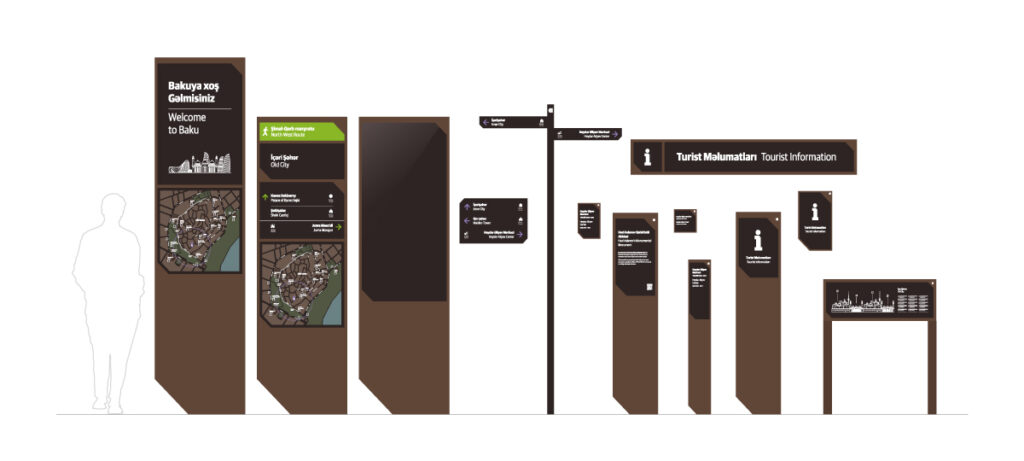
The key is not each individual element. An isolated sign does not constitute by itself an integral signaling system if it is not part of an overall guidance strategy.
Placing signs alone does not create a comprehensive guidance system.
In complex buildings, the wayfinding design and wayfinding system are interdependent parts that work together to ensure that a person can successfully complete the journey to their destination. Facilitar la actividad de Wayfinding tiene ventajas funcionales: autonomía, reducción del estrés y mejora de la experiencia de uso del espacio.
In addition to being an essential public service in environments such as hospitals, its economic and operational impact is also significant.